
Your child can read the Qur'an — but does every letter come out from exactly the right place, with exactly the right sound? That is what Tajweed is. And it is almost impossible to learn from a recording alone, because nobody is listening back and correcting you.
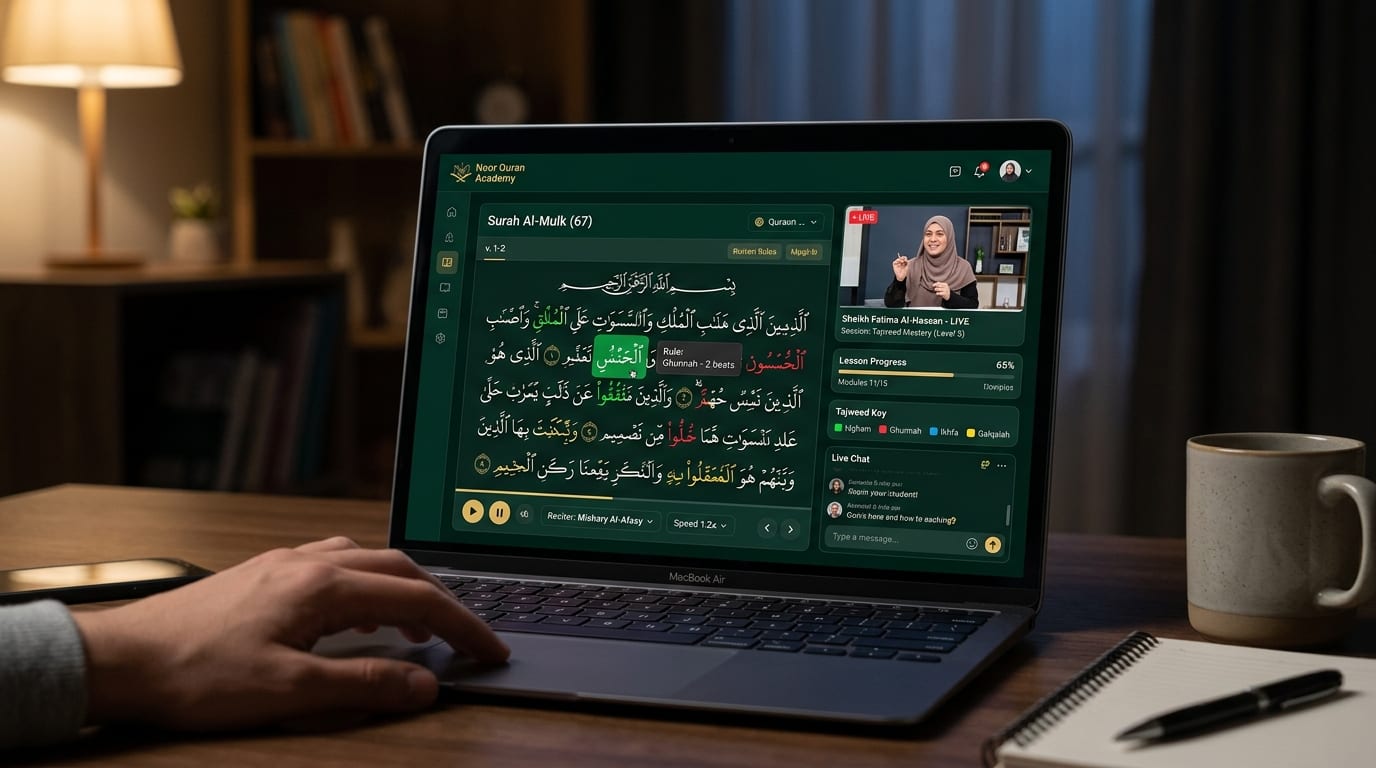
Online Tajweed classes fix that. In a live, one-to-one class, a qualified teacher listens to every ayah you recite, corrects your Makharij on the spot, and builds your recitation rule by rule until it is beautiful and correct. This guide explains what Tajweed really is, how online classes work, the core rules you will learn, the mistakes most learners make, and how to choose a teacher.
What Is Tajweed, Really?
Tajweed means to make something good, beautiful and precise. In Qur'an recitation, it means giving every letter its full right — its correct articulation point (Makhraj), its correct characteristics (Sifaat), and its correct length and sound when it meets other letters.
Allah commands measured, deliberate recitation: "and recite the Qur'an with measured recitation" (Qur'an 73:4). Tarteel — slow, clear, measured recitation — is not a style choice. It is the way the Qur'an asks to be read.
That is why Tajweed is not an advanced extra for a few students. It is the foundation. A child who learns Qaida without Tajweed has to unlearn habits later. A child who learns it with Tajweed from the start recites correctly for life.
Why Online, One-to-One Tajweed Classes Work
Tajweed is a listening skill. You cannot learn it by reading rules in a book, because the rules describe sounds. You need a teacher's ear on your recitation, live, in the moment.
In a one-to-one online Tajweed class, that is exactly what happens. The teacher hears every letter. When your ق (Qaf) comes out too far forward and sounds like ك (Kaf), the teacher stops you, shows you where the sound is made, has you repeat it, and only moves on when it is right. In a group class of twenty, that correction never happens.
Three things make the online format work for Tajweed in particular. First, the class is live and interactive — screen-share, whiteboard, and the teacher's own recitation as a model. Second, the lesson is recorded in the student's progress, so the teacher knows exactly which rules are weak and revisits them. Third, parents get a monthly progress report, so they can see what was covered and how their child did.
For adults, the same format solves the oldest problem in Tajweed learning: embarrassment. Many adults read the Qur'an every day but know their recitation has mistakes, and they will not sit in a circle and be corrected in front of others. One-to-one, with a teacher of their choice, that barrier disappears.
How an Online Tajweed Class Runs
A good Tajweed class follows the same shape every time, so the student always knows what is coming. At AyahLink, every class runs on a fixed interactive structure: a warm-up game, a screen-share lesson, a practice game, dua and questions, a star challenge, and homework.
The lesson itself moves in small steps. The teacher introduces one rule, demonstrates it, has the student repeat it in single words, then in an ayah, then in a short passage. New rules are always practised inside real recitation, never only as theory. Parents receive a monthly progress report: what was covered, how the child did, and what to practise.
That report matters more than it sounds. Tajweed improves between classes, in five or ten minutes of daily practice — but only if the parent knows exactly what to practise. The report tells them.
The Core Rules You Will Learn
Tajweed has many rules, but they build on each other in a fixed order. A master-level course covers all of them, topic by topic. Here is the spine of the curriculum, in the order a student meets it.
1. Makharij — Where Every Letter Is Made
There are 17 articulation points (Makharij) for the 28 Arabic letters. Each letter is made in one exact place: the throat, the tongue, the lips, the nose, or the empty space of the mouth. Change the place, and you change the letter — and sometimes the meaning.
The classic example is ق (Qaf) and ك (Kaf). Qaf is made at the very back of the tongue, against the soft palate. Kaf is made a little further forward. Say قَلْب (qalb, heart) with a Kaf sound and you get كَلْب (kalb, dog). One place, one letter, a completely different word. This is why Makharij comes first, and why it is practised until it is automatic. Our full guide to the 17 points explains each one.
2. Sifaat al-Huroof — The Characteristics of Letters
Every letter also has permanent characteristics (Sifaat): is it heavy or light, does the breath flow or stop, does the sound vibrate? The letters of Qalqalah — ق ط ب ج د, remembered as قُطْبُ جَدّ (Qutb Jad) — bounce with a small echoing sound when they carry a sukoon. Say أَقْ (aq) and feel the bounce; say أَكْ (ak) and feel that there is none. That bounce is Qalqalah, and it is one of the first characteristics a student learns to hear in their own recitation.
3. Noon Sakinah and Tanween — Four Rules
When a Noon with sukoon (نْ) or a Tanween meets the next letter, one of four things happens: Izhar (clear pronunciation), Idgham (merging), Iqlab (changing the sound to Meem), or Ikhfa (hiding it with a light nasal sound). Which rule applies depends entirely on the next letter. Students learn the letter groups, then practise until the rule fires without thinking.
The most common mistake here is rushing Ikhfa. Ikhfa is not silence and it is not a full Noon — it is a hidden sound with Ghunnah (nasalisation) held for about two counts. Learners either skip it entirely or hold it far too long. A teacher listening live catches both in seconds.
4. Meem Sakinah — Three Rules
A Meem with sukoon (مْ) follows the same logic with three rules: Ikhfa Shafawi (hiding before Ba), Idgham Shafawi (merging into another Meem), and Izhar Shafawi (clear pronunciation before all other letters). The trap here is the opposite of Noon Sakinah: students who have just learned to hide the Noon start hiding the Meem everywhere too. Clear rules, practised separately, keep them apart.
5. Madd — Stretching the Sound
Madd is the lengthening of a sound. The natural Madd (Madd Tabee'i) is held for two counts. Other types stretch longer: Madd Munfasil and Madd Muttasil stretch to four or five counts, Madd Lazim to six, and Madd Aarid depends on where you stop. The rule is simple to state and hard to keep steady: every count must be even. Most learners stretch beautifully on the first ayah and rush the third. Counting aloud with the teacher, then counting silently, fixes it.
6. Ghunnah — The Nasal Sound
Ghunnah is the nasal sound that lives in Noon and Meem. When either letter carries a Shaddah ( ّ ), the Ghunnah is held for two counts — no more, no less. It is a small rule, but it changes the whole sound of a passage, and it is one of the easiest to verify: if you can hear the hum held evenly, it is right.
7. Waqf — Where to Stop and Start
The last rule is where to stop. Stopping in the wrong place can break a meaning in half, and starting again in the wrong place can be worse. Students learn the stop signs, which stops are complete and which are only pauses, and how to return to the ayah and resume correctly. Good Waqf is what makes a recitation sound calm and confident instead of breathless.
Common Tajweed Mistakes (and Their Fixes)
After hundreds of one-to-one classes, the same mistakes appear again and again. Here are the five most common, with the fix a teacher uses.
Mistake 1: Heavy and light letters swapped. The heavy letters (خ ص ض غ ط ق ظ) are pronounced light, so صِرَاط sounds like سِرَاط. Fix: practise each heavy letter beside its light partner — ص beside س, ط beside ت — until the ear can tell them apart.
Mistake 2: Madd stretched unevenly. Two counts becomes one, or four becomes six. Fix: count on the fingers while reciting, out loud at first, until the lengths are steady without counting.
Mistake 3: Ikhfa skipped. The hidden Noon is read as a clear Noon, or dropped entirely. Fix: slow down to half speed on every Noon Sakinah for one week. Speed returns on its own once the rule is in the ear.
Mistake 4: Qalqalah missing. The letters ق ط ب ج د are read flat, with no bounce. Fix: exaggerate the bounce for a week — say أَقْ, أَطْ, أَبْ with a clear echo — then soften it to normal. The echo never disappears once it is learned.
Mistake 5: Reciting too fast to apply anything. The student knows the rules but reads at a speed where none of them can be applied. Fix: recite at Tarteel pace (Qur'an 73:4) for one page a day. Speed is the last thing to add, never the first.
How to Choose an Online Tajweed Teacher
Not every online Quran teacher teaches Tajweed to the same standard. Before you book online Tajweed classes, check four things.
First, can the teacher recite with correct Tajweed themselves, and can you hear it? Ask for a short recitation in the trial class. A teacher's own recitation is the standard your child will copy.
Second, is the class truly one-to-one? Tajweed correction needs the teacher's full attention on one reciter. In a group, your child may recite for two minutes in an hour.
Third, does the teacher correct in the moment? A good Tajweed teacher stops you gently, shows you the correction, and has you repeat it until it is right. A teacher who only listens and praises is not teaching Tajweed.
Fourth, is there a monthly progress report? If you cannot see what was covered and what to practise, you cannot support the learning between classes.
At AyahLink, all four are standard: qualified male and female teachers, one-to-one live classes, correction in the moment, and a monthly progress report. The first three classes are free, with no card required, so a parent can hear the teaching before deciding anything.
A 10-Minute Daily Practice That Actually Works
Tajweed is kept alive between classes, not in them. This is the routine our teachers give to parents, and it takes ten minutes.
Minutes 1–2: warm up the letters. Pick three letters from the week's rule and say each one ten times, slowly, feeling where it is made.
Minutes 3–7: recite one short passage — five to ten ayat — at Tarteel pace, applying only this week's rule. Do not try to apply every rule at once.
Minutes 8–10: repeat the hardest ayah three times, then recite the whole passage once through without stopping.
Ten minutes a day, every day, beats an hour once a week. And the Qur'an itself promises that it is made easy to remember and recite: "And We have certainly made the Qur'an easy for remembrance, so is there any who will remember?" (Qur'an 54:17).
Start With Three Free Classes
The honest way to judge a Tajweed teacher is to hear them teach. Book three free trial classes — no card, no commitment — and listen to how your child is corrected, how the rules are explained, and how the class feels. If the teaching is right, you will hear it in the first class.
Book at ayahlinkacademy.com or WhatsApp +92 312 7910551.
Related reading: Advanced Tajweed for Adults · Quran Articulation Points Course · Online Tajweed Classes · Pricing